
The source: a star next door
Almost every story about energy on Earth begins at the same place. NASA describes the Sun as a 4.5 billion-year-old yellow dwarf star, a hot glowing ball of hydrogen and helium at the centre of our solar system, about 93 million miles (150 million kilometres) from Earth. Without its energy, NASA says, life as we know it could not exist here.
That is not a figure of speech. The forms of energy guide quoted the EIA's description of sunshine as radiant energy that provides the fuel and warmth that make life possible. This guide asks two questions about that energy: how the Sun makes it, and how it reaches us across a gap with nothing in it.
How the Sun makes energy
The Sun's energy comes from its core. NASA's fact page puts the temperature there at about 27 million degrees Fahrenheit (15 million degrees Celsius), hot enough to sustain nuclear fusion. In the core, hydrogen is fused to form helium, and those nuclear reactions power the Sun's heat and light.
In the language of the first guide, this is a conversion of nuclear energy, a form of stored or potential energy, into thermal and radiant energy. The EIA describes nuclear energy as the energy that holds the nucleus of an atom together, and notes that large amounts can be released when nuclei are combined or split apart. A power plant on Earth splits uranium; the Sun combines hydrogen.
The outward push of all that energy matters to the Sun itself. NASA explains that the heat in the core creates outward pressure that supports the star's huge mass and keeps it from collapsing. The Sun has been in that balance for billions of years, and NASA's scientists expect it to last another 5 billion years or so before it changes into a white dwarf.
The slow climb out of the Sun
Energy made in the core does not leave the Sun at once. NASA describes how it is carried outward by radiation through a region called the radiative zone, bouncing around so much that it takes about 170,000 years to get from the core to the top of the next layer out, the convection zone. There, large bubbles of hot plasma rise towards the visible surface, much as hot water rises in a pan.
The visible surface is the photosphere, a name that means "light sphere". NASA notes that it is the layer that gives off the most visible light, at temperatures of about 10,000 degrees Fahrenheit (5,500 degrees Celsius), and that most of the Sun's radiation escapes outward from it into space. From there, the trip to Earth is the quick part.
Do not look
NASA's own fact page includes a reminder worth repeating: never look directly at the Sun without proper eye protection.
Crossing empty space
Most waves need something to travel through. NASA's page on the anatomy of an electromagnetic wave explains that water waves and sound waves are mechanical waves: they are disturbances in matter, passed along as molecules bump into each other like falling dominoes. The matter they travel through is called a medium. Without a medium, there is no mechanical wave, which is why sound cannot travel through the vacuum of space.
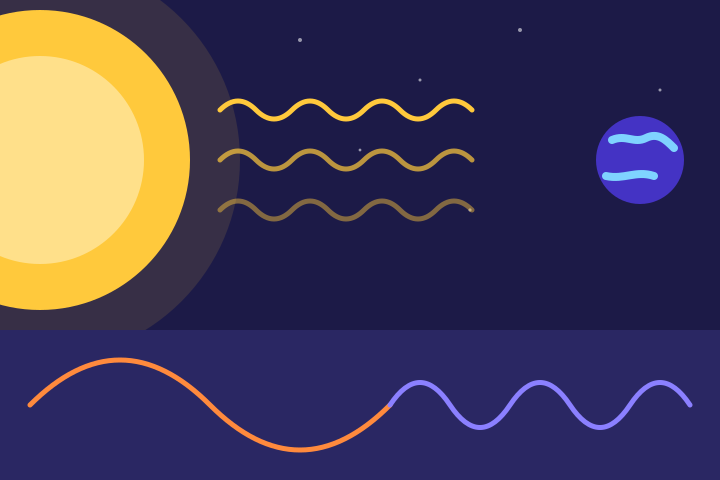
Light is different. NASA explains that moving charged particles, such as electrons and protons, create electromagnetic fields, and those fields carry the kind of energy called electromagnetic radiation, or light. A changing magnetic field produces a changing electric field and the reverse; the two are linked, and together they form electromagnetic waves. Because those waves are made of fields rather than moving matter, they do not need a medium. They can travel through air and solid materials, and also through the vacuum of space.
NASA's history of the idea is short and striking. In the 1860s and 1870s the Scottish scientist James Clerk Maxwell developed the theory showing how electric and magnetic fields couple to form electromagnetic waves. The German physicist Heinrich Hertz later produced and received radio waves and showed that they travel at the same speed as light, proving that radio waves are a form of light. The unit of frequency, the hertz, is named after him.
Waves and photons
Light also behaves like a stream of particles. NASA describes light as made of discrete packets of energy called photons, which carry momentum, have no mass and travel at the speed of light. All light has both wave-like and particle-like properties, and which one shows up depends on how it is measured.
NASA gives two everyday examples. An instrument that spreads light into a spectrum, as a prism does, is observing its wave-like side. A digital camera relies on the particle side: individual photons free electrons in the camera's detector, and those electrons are counted to record the image. A solar panel works on a related principle. The EIA explains that solar photovoltaic cells convert sunlight directly into electricity, without any turbine or moving part.
Frequency, wavelength and energy
NASA explains that light, electromagnetic waves and radiation are all names for the same thing: electromagnetic energy. Any one wave can be described in three linked ways, and if you know one, you can calculate the other two.
- Frequency is the number of wave crests that pass a point in one second. One cycle per second is one hertz (Hz).
- Wavelength is the distance between one crest and the next. NASA notes that the shortest wavelengths studied are fractions of the size of an atom, while the longest can be larger than the diameter of the Earth.
- Energy is often given in electronvolts (eV). NASA describes an electronvolt as the kinetic energy needed to move an electron through a potential of one volt. NIST lists one electronvolt as about 1.602 × 10⁻¹⁹ joules, a very small amount.
The key relationship is simple: moving along the spectrum from long wavelengths to short ones, energy goes up. NASA compares it to a skipping rope pulled up and down at the ends: it takes more energy to make the rope carry more, shorter waves. By convention, scientists describe radio waves and microwaves by frequency, infrared and visible light by wavelength, and x-rays and gamma rays by energy, so that the numbers stay a manageable size. The EIA's list of radiant energy covers the same range, from radio waves through visible light to x-rays and gamma rays.
What sunlight does on Earth
Once it arrives, sunlight drives a remarkable amount of the energy on Earth, often indirectly. The EIA lists the five major renewable energy sources, and the Sun is behind more of them than it first appears:
- Solar energy is sunlight used directly, for heat or for electricity from photovoltaic cells. The EIA notes that solar thermal power plants use the Sun's heat to drive steam turbines.
- Wind energy, the EIA notes, comes from the uneven heating of the Earth by the Sun, which sets air moving.
- Biomass comes from plants, and the EIA counts it among the stores of chemical energy.
Geothermal energy, from heat inside the Earth, and hydropower, from flowing water, complete the EIA's list. The EIA also points out a practical limit of direct solar energy: it is only available during the day, when the Sun is shining. That is one reason electricity grids, described in the next guide, have to balance many sources against demand at every moment.
So the everyday magic of a sunny afternoon has a precise explanation: hydrogen fusing in a core at millions of degrees, a climb lasting many thousands of years, and then a short crossing of empty space as waves of electric and magnetic fields that need nothing to travel through.