
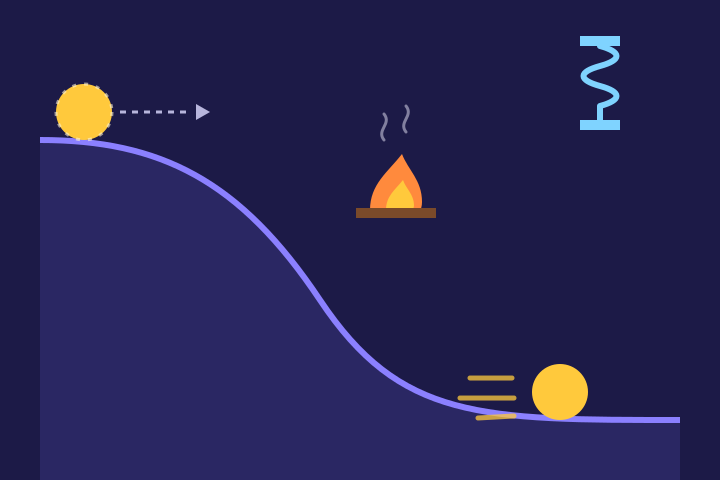
What physicists mean by energy
Scientists define energy as the ability to do work. That short definition, used by the US Energy Information Administration (EIA) in its Energy Explained series, hides a great deal. "Work" in physics has a precise meaning: a force acting on something as it moves. Lifting a bag of groceries onto a shelf is work. So is the push of hot gas on a piston, or the pull of a magnet on a scrap of iron. Anything that can make such a push or pull happen has energy.
The definition is useful because it lets very different things be compared. A moving car, a warm cup of tea, a charged phone battery, a beam of sunlight and a slice of toast all look unrelated. Yet each can, in the right circumstances, be made to do work, and each can be measured in the same unit, the joule. The rest of this guide sorts those everyday examples into a small number of forms, so that the later guides can follow energy as it moves from one form into another.
The EIA makes one more point at the outset: modern life is possible because people have learned to change energy from one form to another and put it to use. Walking, cooking, refrigerating food, lighting a room and sending astronauts into space all depend on energy being converted and used. That idea of conversion is the subject of the next guide.
Two categories: stored and moving
However many forms of energy there seem to be, the EIA groups them into two categories.
- Potential energy is stored energy, the energy of position or arrangement. It is energy that is waiting: in a raised weight, a stretched rubber band, the chemical bonds of a fuel, or the nucleus of an atom.
- Kinetic energy is the energy of motion. The EIA describes it as the motion of waves, electrons, atoms, molecules, substances and objects. It is energy that is doing something now.
NASA's science pages on the electromagnetic spectrum use the same split, giving batteries and water held behind a dam as examples of stored energy and objects in motion as examples of kinetic energy. The two categories are not separate worlds. Energy moves back and forth between them all the time, and following that movement is most of what physics does with energy.
The stored forms
The EIA lists four kinds of potential energy that turn up in daily life.
Chemical energy
Chemical energy is stored in the bonds of atoms and molecules. Batteries, wood and other biomass, petroleum, natural gas and coal all hold it. When wood burns in a fireplace or gasoline burns in an engine, chemical energy is converted into thermal energy. Food is chemical energy too, which is why the guide to energy in food belongs on a physics site.
Mechanical energy stored by tension
A compressed spring or a stretched rubber band stores energy because its material is held out of its natural shape. Let go, and the stored energy is released as motion.
Nuclear energy
Nuclear energy is the energy that holds the nucleus of an atom together. Large amounts of it can be released when nuclei are split apart or joined together. Splitting uranium atoms is how nuclear power plants make heat; fusing hydrogen into helium is how the Sun shines, as the sunlight guide explains.
Gravitational energy
Gravitational energy is stored in an object's height. The higher and heavier the object, the more is stored. The EIA's examples are a bicycle rider picking up speed down a steep hill, and hydropower, where gravity pulls water down through a turbine to make electricity.
The moving forms
The EIA lists five kinds of kinetic energy.
Radiant energy
Radiant energy is electromagnetic energy that travels in transverse waves. It includes visible light, x-rays, gamma rays and radio waves. Sunshine is radiant energy, and it supplies the warmth that makes life on Earth possible.
Thermal energy
Thermal energy, or heat, comes from the movement of the atoms and molecules inside a substance. The faster those particles move, the more thermal energy there is. Geothermal energy is the thermal energy inside the Earth.
Motion energy
Motion energy is the energy of a moving object. The faster it moves, the more it has. It takes energy to get something moving, and energy is released when it slows down. Wind is motion energy in the air.
Sound
Sound is energy moving through a substance in longitudinal waves, alternating squeezes and stretches of the material. It starts when a force makes something vibrate. The EIA notes that the energy carried by sound is typically small compared with other forms.
Electrical energy
Electrical energy is delivered by tiny charged particles called electrons, usually moving through a wire. Lightning is electrical energy in nature. The electricity guide follows it from a power plant to a wall socket.
Why heat counts as motion
It can seem odd that a warm, still cup of tea holds kinetic energy. The motion is there, but at the scale of molecules: they move faster in hot tea than in cold. Thermal energy is the total of all that tiny, disordered movement.
Putting numbers on it
The SI unit of energy, work and amount of heat is the joule, symbol J. The National Institute of Standards and Technology (NIST) expresses it as one newton metre: the work done when a force of one newton acts through a distance of one metre. Every form of energy above can be expressed in joules, which is what makes it possible to say how much of one form turns into another.
For two of the forms, an introductory physics course gives a simple formula. A physics text published on LibreTexts for a Gettysburg College course states them like this:
Kinetic energy K = ½ m v²
Gravitational potential energy U = m g h
Here m is mass in kilograms, v is speed in metres per second, h is height in metres above a chosen reference level such as the floor, and g is the acceleration due to gravity near the Earth's surface, 9.81 metres per second squared. Two things are worth noticing. Kinetic energy grows with the square of speed, so doubling the speed of an object multiplies its kinetic energy by four. And the reference level for height is a choice: potential energy is always measured relative to somewhere.
Example: a dropped book
Worked example
An illustration with round numbers, not a measurement. A book with a mass of 1 kilogram rests on a shelf 1 metre above the floor.
- Its gravitational potential energy relative to the floor is m g h = 1 × 9.81 × 1 = 9.81 joules.
- If it slides off, that stored energy turns into kinetic energy as it falls. Ignoring air resistance, just before it reaches the floor all 9.81 joules are kinetic.
- Setting m g h equal to ½ m v² and solving gives v = √(2 g h), as the LibreTexts text shows. Here that is √(2 × 9.81 × 1), about 4.4 metres per second.
- When the book hits the floor and stops, its kinetic energy does not vanish. Some becomes the sound of the thud, and the rest ends up in other forms, mostly as a very slight warming of the book and the floor.
Notice that the mass cancels out of the speed. A heavier book stores more energy on the shelf, but in the absence of air resistance it lands no faster. That is one of the small surprises that energy reasoning reveals.
One word, one meaning here
In everyday speech, "energy" can mean enthusiasm, a mood or a sense of being well rested. Those are fine uses of the word, but they are not what this site is about. Here energy always means the physical quantity that can do work and is measured in joules. If a claim about energy cannot be stated in those terms and checked against an authoritative source, it does not appear on these pages.
Next: Conversion and conservation: energy changes form, never amount