
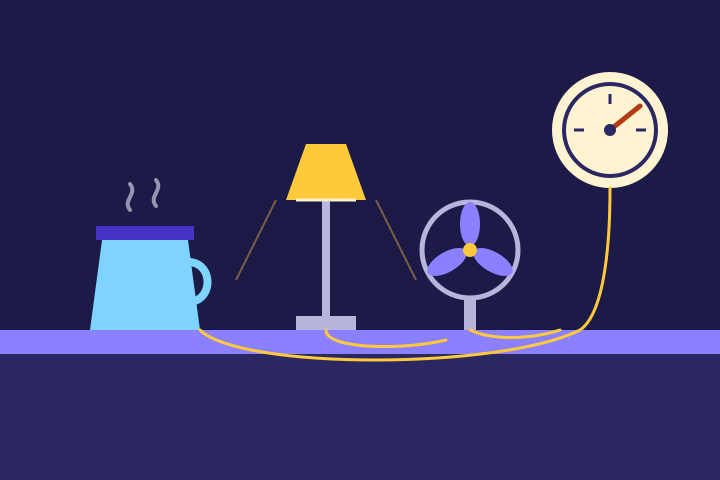
Power and energy are different
Two words are often used as if they meant the same thing, and the difference between them explains almost every number on an electricity bill. Energy is the amount: how much work can be done or how much heat delivered. Power is the rate: how quickly that energy is delivered or used.
NIST's guide to the International System of Units (SI) makes the link exact. The unit of energy is the joule. The unit of power is the watt, and one watt is one joule per second. A device rated at 1,000 watts uses energy at the rate of 1,000 joules every second it runs at that rating.
Energy = power × time
That formula is the whole of household energy arithmetic. A low-power device left on for a long time can use as much energy as a high-power device used briefly. A 50 watt device running for 20 hours and a 1,000 watt device running for 1 hour use exactly the same amount of energy: 1,000 watt-hours.
The kilowatt-hour
Joules are inconveniently small for household use, so electricity is sold in a larger unit. The EIA notes that electricity is measured in kilowatt-hours (kWh), just as gasoline is measured in gallons and natural gas in cubic feet.
A kilowatt-hour is the energy delivered by one kilowatt of power, that is 1,000 watts, for one hour. NIST's table of conversion factors gives its exact size: one watt-hour is 3,600 joules, and one kilowatt-hour is 3.6 million joules, or 3.6 megajoules (MJ).
A unit of energy, not power
The kilowatt (kW) measures power. The kilowatt-hour (kWh) measures energy. An appliance has a power rating in watts or kilowatts; a bill counts the energy delivered, in kilowatt-hours.
Estimating what an appliance uses
Virginia Cooperative Extension, part of Virginia Tech, publishes a simple method for estimating how much electricity an appliance uses. It is the energy formula above, arranged to give kilowatt-hours:
kWh per day = watts × hours used per day ÷ 1,000
Multiply the daily figure by the number of days the appliance is used in a year to get the annual figure. Dividing by 1,000 simply turns watt-hours into kilowatt-hours, because one kilowatt is 1,000 watts.
The extension publication explains where to find the wattage: it is usually stamped on the bottom or back of the appliance, or on its nameplate. If only the current is shown, in amperes, the wattage can be estimated by multiplying the current by the voltage the appliance uses. Most US appliances use 120 volts; larger ones, such as clothes dryers and electric cooktops, use 240 volts.
The same publication lists the range of nameplate wattages found on common household appliances. A few of them give a feel for the spread:
| Appliance | Nameplate wattage |
|---|---|
| Clock radio | 10 W |
| Laptop computer | 50 W |
| Ceiling fan | 65 to 175 W |
| Microwave oven | 750 to 1,100 W |
| Portable heater | 750 to 1,500 W |
| Coffee maker | 900 to 1,200 W |
| Hair dryer | 1,200 to 1,875 W |
| Clothes dryer | 1,800 to 5,000 W |
| Water heater (40 gallon) | 4,500 to 5,500 W |
The pattern is clear: appliances that make heat, such as heaters, hair dryers, clothes dryers and water heaters, draw far more power than those that only move information or a little air.
Example: a portable heater
Worked example
An illustration with invented round numbers; it describes no real home or product. A portable heater rated at 1,500 watts runs for 3 hours on each of 30 evenings.
- Energy per evening: 1,500 × 3 ÷ 1,000 = 4.5 kWh.
- Energy over 30 evenings: 4.5 × 30 = 135 kWh.
- In joules, using NIST's factor of 3.6 MJ per kWh: 135 × 3.6 = 486 MJ.
- To turn the energy into a cost, the extension method multiplies the kilowatt-hours by the rate per kWh on your own electricity bill. Rates vary, so this site gives no price.
The extension publication gives its own worked example in the same form: a 200 watt window fan run for 4 hours a day on 120 days a year uses 200 × 4 × 120 ÷ 1,000 = 96 kWh in a year.
Why real use differs from the label
The nameplate figure is a starting point, not a measurement, and the extension publication gives several reasons why actual use can differ.
- Settings change the power. Many appliances have a range of settings, so the power drawn depends on the setting in use at the time. The nameplate shows the power at its rated draw.
- Some appliances cycle. A refrigerator is plugged in all the time but switches on and off as needed to hold its inside temperature. The publication's rule of thumb for estimating the hours a refrigerator runs at its maximum wattage is to divide the time it is plugged in by three.
- Motors draw more when starting. A meter on a motor will show about three times more current while it starts than when it runs smoothly.
- "Off" is not always off. Many appliances keep drawing a small amount of power when switched off. These standby or "phantom" loads are usually small, a few watt-hours, but they continue around the clock.
Comparing electricity with fuels
Many homes also use a fuel, such as natural gas or heating oil, for heating or cooking. The EIA compares different energy sources by converting them all into one unit, the British thermal unit (Btu), which is the amount of heat needed to raise the temperature of one pound of water by one degree Fahrenheit. Its sample conversion factors include:
- Electricity: 1 kilowatt-hour = 3,412 Btu
- Natural gas: 1 cubic foot = 1,036 Btu, and 1 therm = 100,000 Btu
- Heating oil: 1 gallon = 138,500 Btu
With those factors, any two fuels can be compared. For example, 1 therm of natural gas holds 100,000 ÷ 3,412, or about 29.3 kWh, of heat energy. The EIA notes that its factors are recalculated each year to reflect changes in the quality and composition of fuels, so the exact values shift slightly. Comparing heat content is not the same as comparing how much useful heat reaches a room, because each heating system converts its fuel with its own efficiency, as the conservation guide explains.
Where household electricity goes
Across the whole country, homes are one of the largest users of electricity. The EIA reports that retail sales of electricity to the residential sector in 2025 were about 1.51 trillion kWh, about 37.3% of all US retail electricity sales. It also reports that heating and cooling are the largest annual uses of electricity in homes, and that its Residential Energy Consumption Survey consistently shows air conditioning as the largest single use. Because heating and cooling depend on the weather, the shares change from year to year.
Conservation of energy adds a final, satisfying point. All the electrical energy a home draws has to go somewhere. A heater turns it into warmth directly. A lamp turns it into light and heat. A fan turns it into moving air. Each conversion changes the form of the energy, and the total is unchanged. None of it is destroyed; it is converted, exactly as the first two guides on this site describe.