
Electricity starts with atoms
Before following electricity across a country, it helps to shrink down to the scale where it begins. The EIA's page on the science of electricity starts with the atom. Every atom has a centre, the nucleus, which holds particles called protons, with a positive charge, and neutrons, with no charge. Smaller particles called electrons, with a negative charge, move around the nucleus in layers called shells.
Opposite charges attract, so electrons are held near the protons. The electrons in the innermost shells are held tightly. Those in an atom's outermost shells can be held more weakly, and these outer electrons can be pushed out of place and move from one atom to another. That movement of electrons between atoms is what we call electricity.
Two everyday experiences show it happening. A shock from a door handle after walking across a carpet is a stream of electrons jumping between you and the object: static electricity. Rubbing a balloon on your hair moves electrons into the hair, and because like charges repel, the hairs push away from each other and stand up. Lightning, the EIA notes, is the same thing on a grand scale: electrons moving from one cloud to another, or from a cloud to the ground.
An energy carrier, not a source
The EIA makes a distinction that is easy to miss. The electricity people use at home is a secondary energy source. It is made by converting primary sources, such as coal, natural gas, nuclear energy, solar energy and wind energy, into electrical power. The EIA also calls electricity an energy carrier: it can be converted into other forms, such as mechanical energy or heat, wherever it is delivered.
That is why the question "where does electricity come from?" always has a two-part answer. The energy comes from the primary source. Electricity is the way it is moved from the power plant to the place where it is used. In the language of the conservation guide, it is one link in a conversion chain.
The generator: motion into current
Nearly all electricity is made by one principle discovered in 1831. The EIA explains that the scientist Michael Faraday found that moving a magnet inside a coil of wire makes, or induces, an electric current to flow through the wire. His first generator, the Faraday disk, worked on that link between magnetism and electricity, and it led to the generators in use today.
A modern electromagnetic generator has two main parts, in the EIA's description. Insulated coils of wire form a stationary cylinder called the stator. Inside it turns a shaft carrying an electromagnet, a magnet produced by electricity, called the rotor. Turning the rotor makes a current flow in each section of the coil, and the currents combine into one large current. That current is the electricity that travels through power lines to customers.
The physics is the same conversion each time: the generator takes the mechanical, or kinetic, energy of a spinning shaft and converts it into electrical energy. The EIA notes that generators driven this way account for nearly all US electricity generation.
What turns the generators
Something has to spin the rotor. In most power plants it is a turbine: a moving fluid, which may be water, steam, combustion gases or air, pushes on blades mounted on a shaft and turns it. The EIA's page on how electricity is generated describes the main types, with their approximate shares of US utility-scale electricity generation in 2022:
| Generator | What drives it | Share in 2022 |
|---|---|---|
| Steam turbine (single cycle) | Steam from burning fuel in a boiler, or from nuclear fuel rods | about 42% |
| Combined cycle | Combustion gases from one turbine are used to make more electricity in a second turbine | about 34% |
| Wind turbine | Moving air turning a rotor | about 10% |
| Hydroelectric turbine | Water from a reservoir or river | about 6% |
| Solar photovoltaic | No turbine: cells convert sunlight directly | about 3% |
The shares are the EIA's figures for one year and change over time; they are here to show the variety of ways the same generator principle is driven, not as current statistics. Photovoltaic cells are the main exception to the turbine rule. As the sunlight guide explains, they turn radiant energy into electricity with no moving parts at all.
Why the voltage goes up and down
Voltage is the everyday US name for electric potential difference, NIST notes, and its unit is the volt. Power, the rate at which energy is delivered, is measured in watts, and NIST defines one watt as one joule per second. Those two quantities explain the shape of the grid.
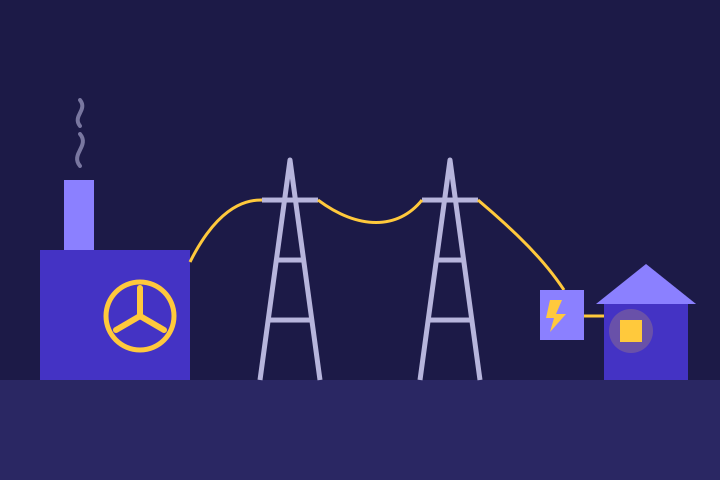
The EIA's page on delivery to consumers describes the journey. Power plants send electricity out through high-voltage transmission lines, such as those strung between tall metal towers, which carry it over long distances. Higher-voltage electricity makes long-distance transmission more efficient and less expensive. Closer to customers, distribution lines carry lower-voltage electricity, which is safer to use in homes and businesses.
The devices that change the voltage are transformers, located at substations. The EIA explains that they either increase the voltage, called stepping up, or reduce it, called stepping down, to suit each stage: up for the long-distance transmission lines leaving the power plant, and down again for the distribution lines that reach homes and businesses.
The EIA's history of electricity adds why this design won out. In the late 1800s Nikola Tesla pioneered the generation, transmission and use of alternating current (AC), which reduced the cost of transmitting electricity over long distances.
Some energy is lost on the way
No conversion or transmission is perfectly efficient. The EIA estimates that electricity transmission and distribution losses averaged about 5% of the electricity transmitted and distributed in the United States from 2018 through 2022. The lost energy is not destroyed: as the conservation guide explains, it leaves the system in forms that cannot be delivered to customers.
The grid as one machine
The whole network of power plants, substations, transformers and lines is called the grid. In the United States, the EIA says, it includes thousands of miles of high-voltage power lines and millions of miles of low-voltage power lines, linking thousands of power plants to hundreds of millions of customers.
The grid has one demanding rule: for it to stay stable, the amount of electricity supplied must match the demand at every moment. In the lower 48 states the grid is organised into three main interconnections, the Eastern, the Western and the one run by the Electric Reliability Council of Texas, which mostly operate independently. Within them, organisations called balancing authorities manage day-to-day operation and make sure that supply constantly matches demand. If the two fall out of balance, the EIA warns, local or even widespread blackouts can happen.
Local electric utilities run the distribution system that connects homes and businesses to the grid. Whoever generated the electricity, the last stretch to a home is the local distribution network.
At the wall socket
By the time electricity reaches a home, it has been generated by a spinning magnet or a solar cell, stepped up for transmission, carried across many miles, stepped down at a substation and again near the street, and delivered through the local distribution lines. Virginia Cooperative Extension notes that most appliances in the United States use 120 volts, while larger ones, such as clothes dryers and electric cooktops, use 240 volts.
Inside the home, the energy carried by that electricity is converted once more, into light, heat, motion and sound, as the home energy guide explains. This site describes the physics only. It gives no wiring or electrical repair instructions; work on household wiring is a job for a qualified electrician.